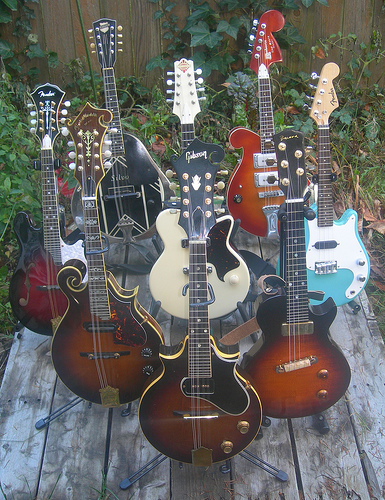

Buy an E-mando
You can't keep them all! Here are a few electric mandolins (and some other stuff) that need loving homes. All instruments will be shipped on 48-hour approval. or call 425.673.0263 if you have questions.
 In stock NOW:           [ to buy one! ]
5-STRINGS.
Fender FM-60E, sunburst. $450.
Here's a semi-hollow 5-string electric from Fender. Nato body with single F-hole, attractive flame maple top, and tobacco sunburst finish. The back, sides, neck, and headstock are finished in black. The FM-60E is one of several models imported by Fender from Korea a few years ago, and was discontinued in 2007.
     Immaculate low action and pleasing jazz guitarlike tone. There are two single-coil pickups, tone and volume controls, and a 3-way selector switch. 18-fret rosewood fretboard with dot inlays, 1-3/8" nut width, 14" scale, chrome hardware, strings-through-body bridge, 5-in-a-line tuners with amber buttons, pearl headstock logo, brown-white bound top.
     Serial number KD00120110. Overall condition is pretty good, but this one does have a scratch in the finish running most of the length of the bass horn above the F-hole, with flaking of the finish in a couple of spots, as well as a couple more small dings and some moderate player wear. Because of this I'm charging a little less than I usually do for an FM-60E. Well set up, with low action. $450 plus shipping with a gig bag, or add a Fender hardshell case for another $50. See more photos, or for more information.

Want to hear what an FM-60E sounds like? Check out this video clip, courtesy of Marcos Moletta in Brazil:


Schwab Deluxe #46, 1983. $1,250.
Here's a 1983 Deluxe model 5-string from Kevin Schwab, the Minnesota-based dean of electric mandolin luthiers. Features include an ash body, nickel hardware, flamed maple top and back, maple neck, ebony fretboard, tortoise binding and single-ply pickguard, Schaller tuners, and a pair of Seymour Duncan humbuckers (switchable). Custom bridge, tone and volume controls. 14.5" scale length, 1.5" nut, shallow U-shaped neck. There's some player wear on the neck and several small dings and chips in the light blonde finish. It's heavy as all get-out, but the Duncans provide plenty of bite and it sustains forever. Access hardshell case included, as is the original brochure from Kevin Schwab with the serial number. A new Deluxe goes for $1,450 these days (without a case); get this one for $1,250 plus shipping, case included. See more photos, or for more information.

G. D. Armstrong solidbody 5-string electric. $950.
G. D. Armstrong is a creative and talented luthier from Oregon. Here's one of his recent 5-string electric mandolins. Mahogany body with Oregon western maple cap, with attractive amber finish. Ebony fretboard with side dots but no fret markers. Planet Waves locking tuners. Andrew Jerman bridge. Top-of-the-line active EMG FT Telecaster-style pickup, along with an EMG Afterburner boost switch knob. Incredible sustain on this instrument, with power and volume to drive anything from a set of Irish tunes to a full-on punk rock assault.
     This mandolin is used but was well cared for; there are no dings, scratches or signs of player wear. It probably won't win a gold medal for precision use of a drill press—the bolts in the neck joint don't form a perfect rectangle like you might expect them to, and the A tuner is a wee bit closer to the E tuner than I'd like (but both tuners are fully operable). Regardless, it's pleasing to look at, and playing it is a fun and rewarding experience. By the way, locking tuners are a wonderful thing, but make sure you know how they work before you try to change strings! Gig bag included, or upgrade to a hardshell case. See more photos, or for more information. $950 plus shipping.

Custom Schwab 5-string, seafoam finish, 2011. $1,550.
I bought this instrument new from Kevin Schwab last year for $1,700. It's been babied since then and is still in like-new condition. It comes with a hardshell case. 14.5" scale length, 1.5" nut, shallow U-shaped neck, Bartolini humbucker, series/parallel switch, tone and volume controls. Nickel hardware. Custom seafoam body with white pearloid pickguard. This one's a showstopper for sure. If you want to look like Eva Holbrook, plus one string, this is the Schwab to get. (If you want to PLAY like Eva ... practice, practice, practice!) $1,550 plus shipping. Includes Access hardshell case. See more photos, or for more information.

Kentucky KM-300E 5-string, late 1980s. $550.
I bought my first electric mandolin in December 1989, with money I had earned from a week's worth of busking Christmas carols on the viola in downtown Seattle. It was one of these: a Kentucky KM-300E 5-string, imported by Saga from Japan. I pressed it into service in the college jazz ensemble/pep band; I remember playing licks from "The Sorcerer's Apprentice" on it during basketball games. Ah, those were the days.
     Somewhere along the way I let that instrument go, and it's taken me the better part of 20 years to pull down another one. This isn't going to replace my beloved Bacorn in my affections, but it's a worthy axe nonetheless. It's hard to remember all the specs from that long ago; this Kentucky has a solid body that might well be mahogany, although I am not certain of the wood species. It has a height-adjustable bridge with a simple metal bar saddle mounted on two bolts that stick straight out of the instrument's surface. Nickel hardware, including a standard Gibson-style tailpiece and open-gear tuners. Black/white pickguard with tone and volume controls. Single-coil pickup with chrome cover. Standard mandolin scale length of 13.875 inches. Tobacco sunburst finish.
     It's not entirely pristine: there are five or six small nicks on the top, and a slightly bigger one on the side, along the bass bout of the comfort-contoured body. There's a music store sticker on the back, which I haven't attempted to remove. The original tailpiece cover was missing, but I have replaced it with one bearing a fancy engraved design. Includes a form-fitting hardshell case with electric blue lining.
     The KM-300E was discontinued not long after I bought mine. Examples of them are thin on the ground. If I were running a museum I would keep this one, but I haven't the space, and anyhow it should be out there getting played. Please don't confuse this mandolin with the 4-string Kentucky KM-300E currently sold by Saga. That's an inferior, entry-level instrument; this one has 5 strings and is, in my humble estimation, a better mandolin. See more photos, or for more information. $550 plus shipping.

4-STRINGS.
JBovier EMC-4, cream, gigbag. $600.
Made in Asia to the exacting specs of Jeff Cowherd, proprietor of JBovier Mandolins, the EMC-4 pays homage to the classic e-mandos of yesteryear while introducing Jeff's own innovations. Enthusiastically received by professional and amateur players alike, the EMC-4 balances great looks with comfort, versatility, and tone.
     Made in 2009, this EMC-4 sports a classic cream finish and tortoiseshell pickguard. It's in excellent condition, but does have some plectrum wear on the black plastic pickup cover. Solid basswood body with solid maple bolt-on neck; radiused maple fretboard with .080" frets. Bone nut and chrome hardware including Wilkinson tuners. Dual "JB-53" custom pickups with 3-way switching: neck, bridge, or both (humbucking). Volume & tone knobs. Includes high-quality padded gigbag with backpack straps. See more photos, or for more information. $600 plus shipping.

1960 Fender Mandocaster. $2,600.
Here's a 1960 Fender Electric Mandolin (affectionately known as the "Mandocaster") in almost-mint condition. Brazilian rosewood slab fingerboard, sunburst finish, tortoiseshell plastic pickguard. Comfort-contoured solid alder body, Kluson tuners, original single-coil pickup. Body date is December 1960. Original brown tweed case with orange lining. From the Norman Harris collection.
     I'm listing this one on behalf of the owner, who's a dear friend of both me and Emando.com; if you're interested in it, I'll put you in touch. See more photos, or for more information. $2,600 plus shipping.

8-STRINGS.
Mid-Missouri EM-8, blond. $800.
Nicely built instrument from this well-known no-frills maker, now operating as Big Muddy Mandolins. Correct me if I'm wrong, but I don't think they are building electrics any longer. This particular EM-8, I'm told, was the in-shop "hot rod" at Mid-Missouri for a while; its Seymour Duncan pickup is custom-wound for extra volume. Maple neck with nonadjustable steel truss rod, ebony fretboard. Five-piece laminated mahogany back and nice blond flame maple top. Seymour Duncan pickup, tone and volume controls. Comes in a padded gig bag, or upgrade to a hardshell case.
     There's a lot of player wear to the finish, both front and back, and there are several chips out of the lower body point. One of the gig bag straps has some damage. I think this instrument was kept in a low-humidity environment for a while, since the ebony fretboard has the beginnings of a crack in it. It's going to the local luthier to have the fretboard conditioned before I turn it loose. Back in the day, the list price on one of these was $1,240, but this one will go for less. Photos coming soon. Please for more information. $800 plus shipping.


Antonio Tsai (Dillion) semi-hollow 8-string mandolin, customized. $325.
Built in Taiwan by Antonio Tsai String Works, this instrument is stamped "Made for Dillion U.S.A." on the back of the headstock. For some reason, this particular mandolin did not end up being branded by Dillion, although others like it have been. I wasn't greatly impressed with the stock electronics, so I've had them upgraded by Indiana builder Andrew Jerman. This is quite the sweet little hot rod now. Frets, action, and intonation are all trouble-free. If I had to guess at what species of wood it contains, I'd say nato. There's a bit of mahogany-like figure to it. Nice-looking mandolin, without all the ostentatious inlay one usually sees on Tsai instruments. Gig bag included, or upgrade to a hardshell case. Please for more information. $325 plus shipping.

National Silvo
National Silvo electric 8-string, 1939. $2,300.
The Silvo was the third and last model of electric mandolin offered by National Res-O-Phonic in the 1930s. It consists of a nickel-plated Style 1 mandolin body, minus the resonator cone and bearing instead the "Silvo" attachment—a Bakelite plate mounted with a primitive-but-effective single-coil pickup, accompanied by tone and volume controls and finished off with a terrific Art Deco design. You can also find Silvo plates on lap steels and tenor guitars, but the mandolins appear to be most plentiful. (That is to say, I've seen only one Silvo tenor [and I own it]; there are perhaps as many as a dozen to 15 of the lap steels extant; but I've easily come across 25 Silvo mandolins in the past 14 years, mostly via the Internet. Which still ain't a whole lot.) Silvos were made in only two years, 1938 and 1939.
     This 1939 example (serial #C976) has benefited mightily from the attentions of professional luthier Gary Wagner in setting it up for correct intonation and maximum playability—which, owing to some unique construction details, was no simple task. It does have a scratch on the headstock and a couple of small pocketknife inscriptions on the cover plate near each of the control knobs (I think a previous owner decided to mark his or her favorite volume and tone settings). A couple of dents on the neck have been filled and touched up.
      Because it has an old Switchcraft screw-on jack, this Silvo requires a special cable attachment, which is included in the price. It includes a semi-hardshell case (not original). Apart from the setup work, which involved reseating the pickup, reconstructing the internal dowel rod, and shaving down the bridge to correct the action, the instrument appears to be all original—except that like nearly all vintage Nationals, it is missing its clear celluloid pickguard. I will include a modern black plastic pickguard and mounting hardware.
     I own a Silvo, as did one of my musical heroes, the late Mark Heard, but I have decided I don't need two of them. As to how it sounds, the Silvo is not an instrument of great erudition. It does respond sweetly to a light touch, but if you dig in, it's rawboned and plaintive, and sounds best with both knobs cranked as far as they'll go. It might not be the ideal choice for your Italian restaurant gig, but do consider it if you need a mandolin whose sound will stand up to gin-soaked, gutbucket, play-it-like-you-mean-it, in-your-face blues, rockabilly, alt-country, Western swing, rock'n'roll, cowpunk, Celtic punk, Americana, or eclectic music. With its 15-inch scale, the Silvo lends itself well to "Yank Rachell tuning," i.e., dropping the pitch to EBF#C# rather than GDAE, which is fantastic for playing blues in sharp keys like E, A, and B. Will gladly consider trades, particularly if you have a working edition of one of the two earlier National wood-bodied electric mandolins—with either the mid-'30s "horseshoe" pickup or the later "New Yorker" pickup. See more photos, or for more information. $2,300 plus shipping.

OCTAVES.
Josh Hegg electric octave mandolin
Josh Hegg electric octave mandolin. $800.
Luthier and gypsy jazz guitarist Josh Hegg of Tacoma, Washington, built this delightful electric octave mandolin. Blond with center stripe, semi-hollow, 3-piece bolt-on neck. Rosewood fretboard and 1-piece bridge, nickel hardware, Allen tailpiece, 20-inch scale. Nut is 1 9/16" wide. Currently set up for GDAE tuning, but could easily be tuned CGDA with a couple of sets of tenor guitar strings.
     This instrument's understated appearance belies how much fun it is to play. The Seymour Duncan humbucker is wired to a 3-way switch, giving you a wide choice of sounds at your fingertips. Play at lower volumes for a pleasant jangling tone, or hit the switch and crank the volume knob for full-on Flogging Molly. Comes with a padded gigbag. See more photos, hear a sample clip, or for more information. $800 plus shipping.

MANDOLAS & TENORS.
Old Wave acoustic/electric mandola, 1991. $2,000.
New Mexico's Bill Bussmann, maker of Old Wave Mandolins, has earned a reputation as a first-rate luthier. He's known not only for the quality of his work, but for using Southwestern-sourced woods and other materials, and for a quirky sense of fun that shines through in some of his more unusual instruments.
     This A-style mandola, serial #91021, is certainly unusual, but Bill disavows having made it so. That is, the Seymour Duncan "Dimebag Darrell" twin-blade humbucker, along with volume control and a pair of switches, were added to the instrument sometime after he built it. A pure acoustic player might not care to have that thing attached to the instrument, but the truth is that this mandola still sounds fine acoustically, with plenty of punch and warmth. Plugged in, you can get tones from "amplified acoustic" to shred-ready, depending on how far you're willing to turn it up. It's strung with nickel-steel strings to take advantage of the pickup. I'd love to try some flatwounds on it, but haven't done so yet. I will include a set of La Bella "JazzDola" flatwounds with it, if you want.
     Spruce top, figured maple back and neck, 17" scale, blond finish, simply gorgeous. Some pickwear on the treble bout, but in really good condition otherwise. If I read the serial number right, this is Bill's 21st instrument, built in 1991. He doesn't make F-hole mandolas any more, and charges $3,200 for a new oval-hole A-style mandola. This one comes in a heavy-duty, super-padded Weber hardshell case. See more photos, or for more information. $2,000 plus shipping.

Schwab 4-string electric tenor guitar. $1,350.
Here's a gorgeous custom electric tenor guitar from Kevin Schwab, the Minneapolis-based dean of electric mandolin luthiers. Kevin reports that he made only a "couple" tenors, but this instrument (#133) is all Schwab, with appointments similar to his "MLS" electric 4-string mandolins. Reddish brown finish and tortoiseshell plastic pickguard. Solid alder Tele-style body; thin, fast maple neck; ebony fretboard with 22" scale. The instrument is appropriately scaled for a tenor; i.e., it's not just a standard Tele body with a 4-string neck bolted on. Banjo-style Planetary tuners with ebony buttons. There are two Bartolini humbucking pickups, governed by a three-way selector switch. In addition, a second toggle control switches the humbuckers from series to parallel and back again. So you can get six different tone colors out of these pickups just by switching—not to mention the standard tone and volume controls. Currently set up with flatwound strings, appropriate for standard CGDA or an open tuning. If you want to use Chicago (DGBE) or octave mandolin tuning, you might need to restring it. Overall, it's in excellent condition, although it has a minor finish blemish near the bottom strap button, which appears to have been caused by leaving it on an instrument stand before the finish was fully cured.
     Plays like a dream and sounds warm and full. Comes in a chipboard guitar case that Kevin custom-padded to make it fit like a glove. New, the instrument and case together cost $1,650. Get it here for $1,350 plus shipping—and pat yourself on the back for nabbing one of the few Schwab e-tenors in existence. See more photos, or for more information.

National Style 1 Tricone Tenor (1928). $2,250.
There's nothing cooler than a National Res-O-Phonic tenor guitar, and if you ask me, the coolest of the Nationals is the tricone. Instead of a single resonator cone, these instruments contain three mini-cones, all connected via an ingenious three-armed bridge. The resulting tone is at once twangy and sweet, like a really good pineapple. This is a Style 1 tricone, so it's finished in plain "German silver" (actually a nickel-steel alloy) without all the fancy engraving of the Style 2 and 3 models. Nonetheless, it still looks super sharp, plays easily, and sounds sublime.
     The serial number is 462, which dates this instrument to 1928, the first year of production, according to the serial number lists published in Bob Brozman's book The History & Artistry of National Resonator Instruments. The National shield logo decal is intact, and the instrument appears to be all original, including the Planetary banjo-style tuners. It's in really, really good condition. Neck is straight and it's easily playable, even on the higher frets. There are a few minor impressions in the pear-shaped metal body (I wouldn't even call them dents) and a slight chip on the headstock. Wear on the T-shaped bridge cover and the back of the maple neck indicates that this tenor got a lot of playing time. That's not a bad thing—the good ones get played!
     I'm finding it difficult to express how much fun it is to play this thing. I can hardly put it down! Ragtime, blues, gospel, bluegrass, singer/songwriter stuff, novelty numbers—everything I've tried sounds great on this instrument. Buy it quick, before I change my mind about selling it! Sadly, the original case is gone, but I will include a gig bag. (I've carried my own National Triolian tenor in a gig bag since 2004, including a trip to Greece, and never had a problem with it.) See more photos, or for more information. $2,250 plus shipping.

Want to hear another 1928 National Style 1 tricone tenor in action? Check out this video clip, courtesy of Jacob Ullberger in Sweden:


Lyon & Healy Style A mandola, ca. 1922, acoustic. $4,000.
Here's a rare Lyon & Healy Style A mandola, circa 1922. It has undergone several repairs. The ebony bridge is a custom-made replacement. The headplate was cracked and has been expertly reglued. The tailpiece cover, although an authentic 1920s Lyon & Healy, is not original to the instrument. Other hardware (pickguard, tailpiece base, tuners) appears to be original. The serial number is 1500.
     The lovely violin-style headstock, unfortunately, took a bad blow and was severely cracked at some point in the past. The crack was reglued before I acquired the mandola. It is not a very good-looking repair, but it is holding up. It hasn't gone anywhere in the eight months I have owned the instrument.
     Spruce top and flame maple back/sides show some scars and signs of wear, but there are no body cracks, splits, open seams or other concerns. Original case is gone; it now resides in a vintage rectangular Maulbetsch & Whittemore double violin case, lined in red velvet, which has been modified to fit the mandola. It isn't a very tight fit, so I will include some pads that should help keep the mandola safe inside the case.
     Lyon & Healy carved mandolas are almost impossibly scarce; you might have seen the recent Eastman reproductions but few people have encountered an original. There is little pricing information to go on, but one did sell at auction in recent years for $6,000 (it was in much better shape than this one). Another one, finished in chocolate brown rather than blonde, is known to belong to David Grisman; it was the basis for the Eastman copies. Then there is this one. And that's it—this is one of only three such instruments I have beheld, whether personally or photographically. (Sol Goichberg's New York Mandolin Quartet reportedly played upon a matched set of Lyon & Healys in its day, which must have included a mandola, but I do not know what became of that instrument.)
     15-3/4" scale. Beautiful, warm, throaty, shimmering tone with exceptional projection. You can get an idea of what it sounds like in these YouTube clips, which feature me playing this instrument as part of a pickup bluegrass ensemble at the 2010 Classical Mandolin Society of America convention:

http://www.youtube.com/watch?v=DalZ25LIJ6c
http://www.youtube.com/watch?v=RsPkaHsnxws

     I loaned it to some other players at the convention and received very positive comments about its tone and playability. Currently set up with Thomastik flatwound strings. $4,000 plus shipping.
     See more photos, or for more information. $4,000 plus shipping.

ACOUSTIC & ACOUSTIC-ELECTRIC.
GoldTone GM110, tobacco sunburst. $450.
This is GoldTone's licensed copy of a Rigel G110, designed to emulate the classic Rigel appearance and playability at a budget price point.
     It's not a Rigel, but it will most definitely get the job done if you need an acoustic-electric that doesn't break the bank. For some reason, this GM110 originally lacked a pickup, but it's had an Artec PP-407M piezo pickup installed. Solid maple back and sides; solid spruce top; maple neck reinforced with truss rod. Bound ebony fretboard. Excellent condition. Gig bag included, or upgrade to a hardshell case.
     See more photos, or for more information. $450 plus shipping.


Dave Griffin A5, 2002, acoustic. $1,250.
This charming standard mandolin from Golden, Colorado luthier Dave Griffin features a spruce top, segmented F-holes, flat ebony fretboard with abalone inlays, a whimsical headstock design with inlaid rose, and gorgeous rosewood back and sides. To my ears, the rosewood adds a lot of warmth compared to your average maple-backed mandolin. It's more complex than, and not quite as bright as, a typical bluegrass mandolin. But make no mistake—hit a few chop chords on this and you'll hear that it has plenty of bluegrass bark too! It's recently set up and features extra-low action. Reddish sunburst finish, Brekke bridge, 1-piece Keith Newell tailpiece. Very good condition, except it used to have a pickguard and now it doesn't. Hardshell case. Hear a sound clip, see more photos, or for more information. $1,250 plus shipping.

Gibson A2Z, 1923, acoustic. $5,500.
Meet "Rosie," a delicious blond 1923 Gibson A2Z snakehead mandolin. Her serial number is 75651. She comes with her original green-lined case (handle re-covered). All her hardware is original except for her repro ebony endpin with MOP dot, which was made and installed by Gail Hester. Gail also did the setup work (fret dress, reglue binding and brace, refit bridge, lube tuners, adjust truss rod). Rosie sings like a bird, with sweet, resonant oval-hole tone. She's a charmer, with her hand-painted floral design on her pickguard and truss rod cover. Unfortunately, I have two vintage snakeheads and can't keep them both. I never thought I would break Rosie's heart like this, but that's life. See more photos, or for more information. $5,500 plus shipping.

Gibson A4, 1924, acoustic. $6,000.
Meet "Rita," a seductively charming 1924 Gibson A4 snakehead mandolin. Her serial number is 78318. She comes with her original green-lined case (with replacement handle). She boasts her original tailpiece, pickguard and endpin. Her bridge is a high-quality Loar-style repro by Cumberland Acoustics. Her tuners, although they are replacements, are period-correct Waverlies with arrow-end plates, exactly like the ones she was born with.
     Restoration/setup work by renowned luthier Gail Hester included fitting the bridge, installing the tuners and refretting Rita with vintage-style wire. Rita boasts an extended fretboard, an enticing sunburst spruce top, and a mysterious backside that's either unusually figured birch or very lightly figured maple. Her golden-throated, dulcet tones will lead you astray; her voice is full-bodied and complex.
     Rita hasn't always chosen her partners well ... a former owner appears to have used pliers, and rather clumsily at that, when changing her strings, and her headstock is heavily scratched as a result. She is worthy of better, much better. Could you be the one to give her the attention she deserves?
     Unfortunately, Rita hasn't been the only vintage snakehead in my life. My loyalties are divided between her and Rosie, but now it is time for me to cling to one and shun the other. A man's gotta do what a man's gotta do. Rita may be fourscore and seven, but the two of you could still share a lifetime of beautiful music.
     See more photos, or for more information. $6,000 plus shipping.

A-style mandolin No. 181 by John D'Angelico, 1952, acoustic. $8,250.
By any measure, John D'Angelico of New York was one of the greatest American luthiers of the 20th century. He is most celebrated for his jazz guitars, but did find the time to craft only about 50 mandolins in his career. This is one of them.
     Upon leaving Mr. D'Angelico's workshop, No. 181 attended the school of hard knocks upstate in Schenectady. It acquired some heavy wear along the bass side of its spruce top (perhaps its master owned some substantial cufflinks); was fitted, semi-permanently, with a DeArmond pickup; then was neglected for many years, causing its original celluloid pickguard to "outgas" into a state of advanced decay. It has since been restored, with a new pickguard (which incorporates the original 4-ply binding), a vintage engraved Waverly "cloud" tailpiece, a rebound headstock, cleaned and polished frets, and removal of the badly corroded pickup (although the old 1/4-inch jack remains in the lower treble side). It comes with the original hardshell case.
     Headstock bordered in celluloid with black and crème purfling; the top and back are bound with 7-ply purfling. Single-ply bound soundholes. Original bone nut is 1-1/8" wide. Lightly flamed maple back and sides; strongly flamed maple neck. Ebony fretboard with 13-7/8" scale, original frets. Tone bar bracing. Original ebony adjustable bridge, tuners, and hardshell case.
     She's seen fire and she's seen rain, but nothing this mandolin has been through seems to have detracted from her tone, which is orchestral in its complexity and tropical in its warmth. In mint condition, or even in mint julep condition, we could well be talking about $12–14,000 for a fancy D'Angelico A (and more for his deluxe models). Whereas, this well-worn wonder can tell you the things it has lived to tell for a (relatively) more modest sum.
     Although D'Angelico No. 181 belongs to me, it is on consignment with Mandolin Bros. of Staten Island, N.Y. (where the leading authorities on D'Angelico instruments live, move, and have their being), which performed all the restoration work and will handle all particulars of its sale. Please check out the Mandolin Bros. listing for additional photos and information. $8,250.

OTHER.
Vega Tubaphone mandolin banjo, 1921, with pickup. $1,750.
Now here's something you don't see every day. This vintage Vega Tubaphone mandolin banjo (serial #40002) is in fine original condition. It features ornate inlay work on the headstock, heel, and ebony fretboard; exquisitely detailed marquetry along the rim; an engraved tailpiece; and a gorgeous flame maple neck. All original parts are there, as is a professionally installed pickup. If you thought the mandolin banjo was an instrument you couldn't take seriously, this one will change your mind. It's perfectly set up in excellent playing condition, and unlike most of these instruments I've tried, it actually has tone! Very mellow, sweet and full. And loud. And that's before you plug it in. Comes with the original hardshell case. See more photos, or for more information. $1,750 plus shipping.

Call 425.673.0263 or if you're interested in any of these mandolins.

CASES.
Buy one of the instruments listed above and upgrade the gig bag to a hardshell case. You'll save 10 percent—or 10 bucks, whichever is more—on the case when you do. Or you can buy a case outright at the listed price. I'll keep an eye out for good secondhand cases to offer here.

Access rectangular hardshell case. $100.
Here's a recent high-quality Access "Stage 3" mandolin case in like-new condition. Universal fit design holds most F-style, A-style, or electric mandolins, right-handed or left-handed. The strong rectangular wooden shell has a rugged black exterior covering, plush padded interior, accessory compartment, strong latches and sturdy comfortable handle. Holds instruments up to 10" wide and 26" long. for more information. $100 plus shipping.

Weber mandolin case with Colorado Case cover. $200.
Weber hardshell cases are some of the best mandolin cases out there. They're heavy duty with extra padding. This one's made for an F-style acoustic mandolin; it'll fit some electrics but not others. As far as I know, Weber doesn't sell these cases separately from mandolins, so they are not easy to find. This one comes with a thermal cover from Colorado Case Co., which in itself is a $169.95 value. for more information. $200 plus shipping.

Protec Pro Pac PAG 208 mandolin case. $75.
These popular cases were discontinued a while back, and are officially unavailable, as you know if you've been looking for one. Here's a slightly used one in very good condition. It's not the sexiest mandolin case ever designed, but is possibly the most versatile. Celebrated among discriminating mandolinists for its ability to accommodate nearly any style of mandolin (I kept a Dobro mandolin in one for a while) and a boatload of accessories, the Pro Pac features a durable and highly protective lightweight frame, adjustable padded shoulder strap, padded handles, protective feet, and an ID tag. Other features:
  • Velcro "quick lock"
  • Soft velvoa lining
  • Padded handle grip secured by Velcro
  • Extra interior pad for a custom fit to your instrument
  • Accessory compartment
  • Durable 1000 denier nylon; water and abrasion resistant
  • Roomy exterior pocket
  • High-quality YKK zippers
  • Nickel-plated hardware
  • Interior dimensions: 28-1/2" x 12" x 4"
  • Built-in organizer to hold pens, keys, and small accessories
for more information. $75 plus shipping.


Shipping & payment
I will ship anywhere within the United States and Canada, and to many international destinations. I will not mark your purchase as a gift, declare a lower value, or commit any other customs fraud, so don't ask. You pay for shipping by the carrier of your choice: FedEx, UPS, or U.S. Postal Service. A 48-hour approval period is offered on any shipped instrument. If you live in the greater Seattle area, you can arrange to try out any in-stock instrument in person.
     You can pay by PayPal, money order, or cashier's check (or cash, for local transactions). If you're interested in any of these instruments, to arrange a transaction.